
Breast cancer is the most common cancer among Nigerian women. It is also one of the most survivable when caught early. The problem is that in Nigeria, too many women are diagnosed at an advanced stage, when the cancer has already spread, and treatment is far more difficult. The single most powerful thing that changes this reality is awareness, knowing what to look for, acting quickly when something feels wrong, and not waiting until pain forces a visit to the clinic.
This article is your practical guide to the early signs of breast cancer, what to check for at home, when to see a doctor, and what screening is available to you in Nigeria.
Why This Matters in Nigeria
Breast cancer accounts for the largest share of cancer diagnoses and cancer deaths among Nigerian women. According to the World Health Organization, breast cancer is the most frequently diagnosed cancer globally in women, and in low- and middle-income countries like Nigeria, survival rates are significantly lower, not because Nigerian women get a more aggressive cancer, but because most cases are caught late.
The five-year survival rate for breast cancer caught at Stage 1 is over 90%. By Stage 4, that rate drops dramatically. Early detection is not just helpful; it is the difference between life and death.
What Is Breast Cancer?
Breast cancer occurs when cells in the breast grow abnormally and uncontrollably, forming a lump or tumour. It can start in different parts of the breast, but most commonly in the milk ducts (ductal carcinoma) or in the milk-producing glands (lobular carcinoma).
Breast cancer can affect anyone with breast tissue, women overwhelmingly, but also men in rare cases.
It is not one disease but a group of diseases. Some types grow slowly; others are more aggressive. This is why early detection at any stage matters; the earlier the cancer is found, the more treatment options are available and the better the outcomes.
Early Signs and Symptoms to Watch For
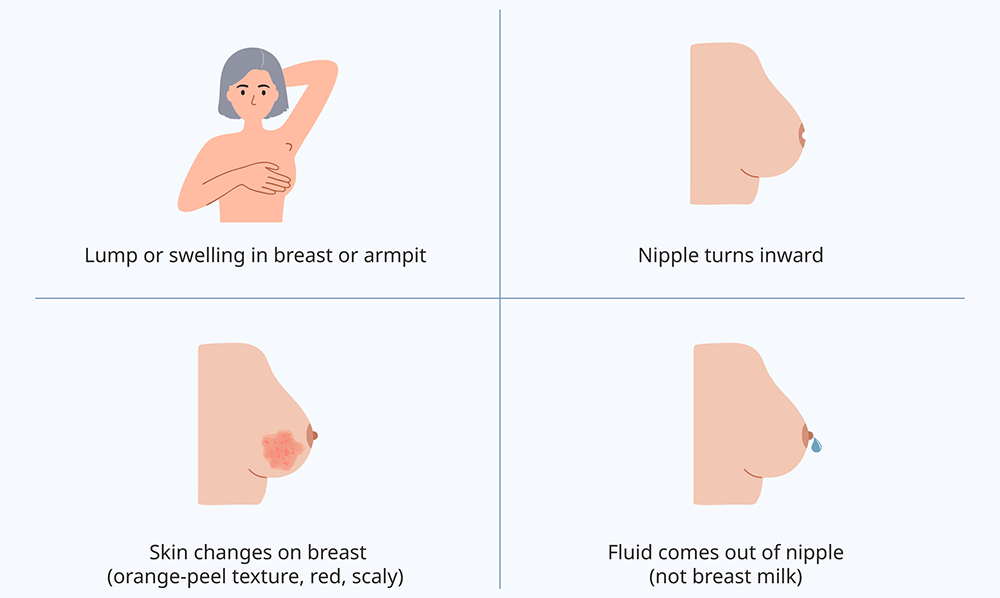
Most early breast cancers do not cause pain. This is why relying on pain as a warning sign is dangerous. Instead, look for these changes:
1) A New Lump or Thickening in the Breast or Armpit
The most recognised sign of breast cancer. Not all lumps are cancer; many are benign cysts or fibroadenomas, but any new lump should be evaluated by a doctor promptly. Cancerous lumps are often hard, have irregular edges, and do not move easily when pressed. However, some cancerous lumps are soft, so do not dismiss a lump based on texture alone.
2) Change in Breast Size or Shape
One breast suddenly appearing larger, lower, or shaped differently than before, especially if this is a new change, should be checked.
3) Skin Changes on the Breast
- Dimpling: skin that looks puckered or pulled inward, like the surface of an orange peel (called peau d’orange). This is a significant warning sign.
- Redness or rash: persistent redness, warmth, or a rash on the breast that does not resolve
- Thickening of the skin: skin that feels thicker or harder than usual over part of the breast
4) Nipple Changes
- The nipple has recently turned inward (inverted) when it was not before
- Nipple discharge, especially if it is bloody, clear, or happens without squeezing, and from one breast only
- Rash, crusting, or sores around the nipple (which may indicate a rare form called Paget’s disease of the breast)
5) Persistent Breast Pain in One Spot
While breast pain is more often hormonal and benign, pain that is persistent, localised to one area, and not related to your menstrual cycle should be evaluated.
6) Swelling in the Armpit or Around the Collarbone
Lymph nodes in the armpit and neck area drain the breast. Swelling or a lump in these areas can indicate that cancer cells have spread to the lymph nodes, a sign that the disease has progressed.
Breast Self-Examination: How to Check Yourself at Home
Breast self-examination (BSE) is not a replacement for clinical screening, but it builds familiarity with your own body so that changes become noticeable. The American Cancer Society recommends that women know how their breasts normally look and feel and report any changes to a healthcare provider.
How to do it:
Step 1: In front of a mirror: Stand with your arms at your sides. Look at your breasts for any changes in size, shape, or skin. Then raise your arms above your head and look again. Press your palms on your hips and look once more.
Step 2: Lying down: Lie flat and place your right arm behind your head. Use the finger pads of your left hand to feel your right breast in small circular motions, moving from the outside toward the nipple. Cover the entire breast and armpit area. Repeat on the other side.
Step 3: In the shower: Raise one arm. Use soapy fingers to feel the breast and armpit in circular motions. Many women find lumps more easily this way.
When to do it: Once a month, about a week after your period ends (when breasts are least tender). Post-menopausal women can pick any consistent day of the month.
What to do if you find something: Do not panic, but do not wait. Book an appointment with a clinician within 1-2 weeks. Most findings are benign, but only a clinical examination can confirm this.
Clinical Screening: What Is Available in Nigeria?
Clinical Breast Examination (CBE)
A doctor or nurse physically examines both breasts and lymph nodes. This should be part of every routine health check for women aged 20 and above. It takes a few minutes and is not painful.
Mammogram
An X-ray of the breast tissue can detect lumps or abnormalities too small to feel. It is the gold standard screening tool for breast cancer. Recommended for:
- Women aged 40-74 every 1-2 years (standard guideline)
- Women with a family history of breast cancer often start earlier (discuss with your doctor)
Mammography is available at selected private hospitals and diagnostic centres in Lagos and other major cities. Access remains limited in many parts of Nigeria, making clinical examination and self-awareness even more critical.
Ultrasound
A breast ultrasound uses sound waves to create images of breast tissue. It is widely used in Nigeria as it is more accessible than mammography. It is particularly useful for:
- Younger women with denser breast tissue
- Investigating a lump found on examination
- Following up on an abnormal mammogram result
Biopsy
If a suspicious lump or abnormality is found, a small tissue sample is taken and examined in a laboratory to determine whether it is cancerous. This is the only definitive way to diagnose breast cancer.
At Pretty Healthcare, diagnostic services are available. Speak with our clinical team about breast health screening options right for your age and risk level.
Who Is at Higher Risk?
While breast cancer can affect any woman, certain factors increase risk:
- Family history: a mother, sister, or daughter with breast cancer significantly increases your risk
- Age: risk increases with age, particularly after 40
- Early first period or late menopause: longer lifetime exposure to oestrogen
- Having children late or not at all: increases lifetime oestrogen exposure.
- Obesity, especially after menopause: excess fat tissue produces oestrogen
- Alcohol consumption: Even moderate drinking is linked to increased risk
- Previous breast conditions: certain benign conditions increase cancer risk
- BRCA1 or BRCA2 gene mutations: hereditary mutations that dramatically raise risk (genetic testing is available for high-risk individuals)
Having risk factors does not mean you will develop breast cancer. It means you should be more vigilant about screening and speak with your doctor about a personalized plan.
Myths About Breast Cancer in Nigeria
“Breast cancer only affects older women.” False. Breast cancer occurs in younger Nigerian women at notably high rates. Women in their 30s and 40s are diagnosed regularly. Age is a risk factor, not a guarantee of safety in youth.
“If there is no pain, it is not cancer.” False. Early breast cancer almost never causes pain. Pain is more often a sign of benign conditions like fibrocystic changes. Painless lumps are frequently more concerning.
“Only women with a family history get breast cancer.” False. The majority of breast cancer cases occur in women with no family history. Family history increases risk, but is not required.
“Wearing a bra or using deodorant causes breast cancer.” False. No scientific evidence supports either of these claims.
“Breast cancer is a death sentence.” False, especially when caught early. Stage 1 breast cancer has an excellent survival rate with treatment. Early detection saves lives.
Nigeria-Specific Tips
- Do not delay seeing a doctor because of cost. Many cases that become expensive and difficult to treat started as early-stage, manageable diseases
- Talk to your mother, sisters, and daughters about breast health. Awareness shared within families saves lives.
- If you have a family history of breast or ovarian cancer, speak to a clinician about earlier and more frequent screening.
- Several NGOs in Nigeria run free or subsidised mammography and breast examination days – follow the Lagos State Ministry of Health and cancer awareness organisations for announcements.
- October is Breast Cancer Awareness Month globally. Use it as a prompt to book your annual clinical breast exam.
When to See a Clinician
See a doctor as soon as possible if you notice:
- Any new lump in your breast or armpit
- Skin dimpling, puckering, or redness
- Nipple discharge, inversion, or crusting
- Any change in breast size or shape that is new and unexplained
- Persistent one-sided breast pain
Do not wait to see if it goes away on its own. Do not wait until your next scheduled check-up if the change is new. Early action is everything.
Quick Reference Summary
| Most common sign | A painless lump in the breast or armpit |
| Other signs | Skin dimpling, nipple changes, discharge, shape change |
| Self-check | Monthly breast self-examination |
| Clinical screening | CBE annually from age 20; mammogram from age 40 |
| Higher risk? | Family history, age 40+, obesity, alcohol use |
| Most important action | Report any new change to a clinician promptly |
Bottom Line
Breast cancer is common, but it is not a silent killer when you know what to look for. The combination of monthly self-examination, annual clinical breast examination, and mammography from age 40 gives you the best possible chance of catching any problem early when it is most treatable. In Nigeria, where so many women are still diagnosed late, your awareness and action can change your outcome entirely.
Book a clinical breast examination at Pretty Healthcare, Ikeja, Lagos – prettyhealthcare.com.ng/diagnostics or chat with our health advisor on WhatsApp. We are open Monday – Friday: 8am – 5pm and Saturday: 9am – 4pm.